

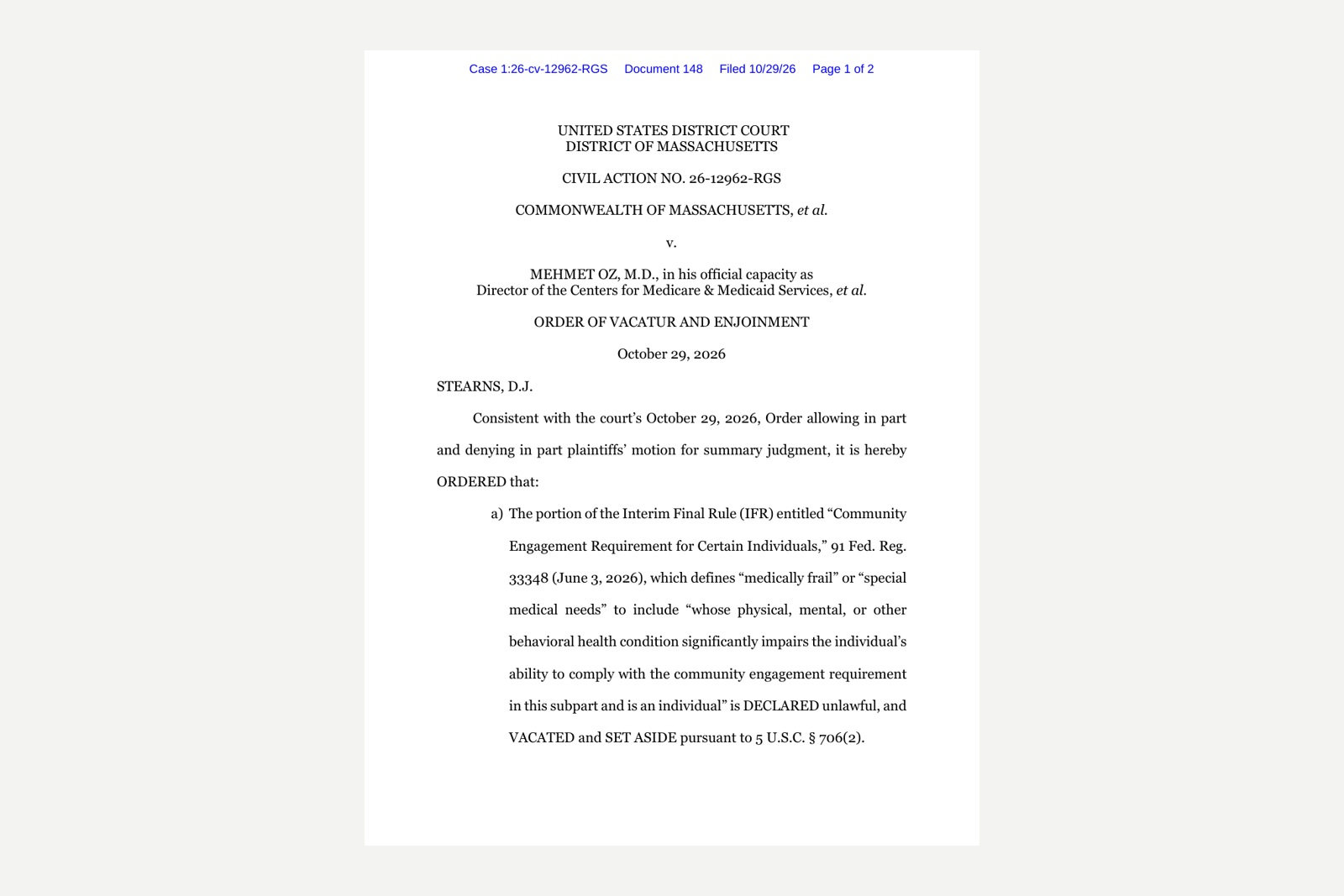
A federal judge struck down a provision of a Medicaid rule that would have required people in protected medical categories to show that their condition significantly impaired their ability to meet coming work, education or community-service requirements.
U.S. District Judge Richard G. Stearns ruled Oct. 29 that the Centers for Medicare & Medicaid Services had added a restriction Congress did not authorize. The requirements begin Jan. 1, 2027, and apply mainly to adults covered through the Affordable Care Act Medicaid expansion. They call for 80 hours a month of work or community service, or at least half-time enrollment in an education program.
Congress's exemption categories include people with blindness or disability, substance use disorder, a disabling mental disorder, certain disabilities affecting daily activities, and serious or complex medical conditions. The law calls this the medically frail or special-medical-needs exemption.
Stearns' 16-page decision in Massachusetts v. Oz concluded that CMS could not impose the additional impairment requirement on those categories.
The government argued that listing the medical categories did not mean the exemption had to cover every person within them. Stearns rejected that reading.
The court upheld two other challenged restrictions: a 12-month limit on medical claims and encounter data used for verification, and a limit of one self-attestation per continuous enrollment period. Self-attestation is a person's own statement about their condition. The ruling did not strike down Congress's work-requirement law.
What the separate enforcement order says
Stearns' Oct. 29 enforcement order sets aside the added language and bars the government from applying it to the states that sued. It also bars the government for six months after Oct. 29, a period ending April 29, 2027, from penalizing those states for errors or delays in implementing the rule.
In the opinion, Stearns explained that the protection concerns medical-frailty determinations while states change their verification systems. The opinion expressly says that the six-month protection does not change the law's Jan. 1, 2027, implementation deadline.
Connecticut, Massachusetts, Maine, Rhode Island and Vermont were among the plaintiffs. New Hampshire was not. The order does not put a geographic limit on its provision setting aside the rule language. Its injunction and six-month protection name only the plaintiff states. The Signal found no CMS statement explaining how it will apply the ruling in New Hampshire.
Stearns entered final judgment Oct. 29, recording the states' partial victory and closing the case at the trial-court level. As of its 11:04 a.m. Nov. 2 update, CourtListener's public docket copy showed no filing after the judgment. That copy can lag the official court record; it does not establish whether a later appeal has been filed.