

Connecticut's new school accountability results show a higher four-year graduation rate and fewer students chronically absent, alongside weaker progress toward academic growth targets in English and mathematics.
The 2025-26 results released Oct. 27, 2026 report a four-year graduation rate of 91.2%, compared with 88.9% in the previous report. The six-year graduation rate for high-needs students moved the other way, falling from 87.3% to 85.8%. Chronic absenteeism fell from 17.2% to 16.4%.
Connecticut counts a student as chronically absent after missing at least 10% of enrolled school days for any reason, according to its attendance definitions. The calculation excludes prekindergarten. The latest rate remains above the 10.4% reported for 2018-19, before the pandemic.
Achievement and growth tell different stories
The state's English and math performance indices rose slightly. Those indices summarize achievement; they are not the percentage of students who passed a test.
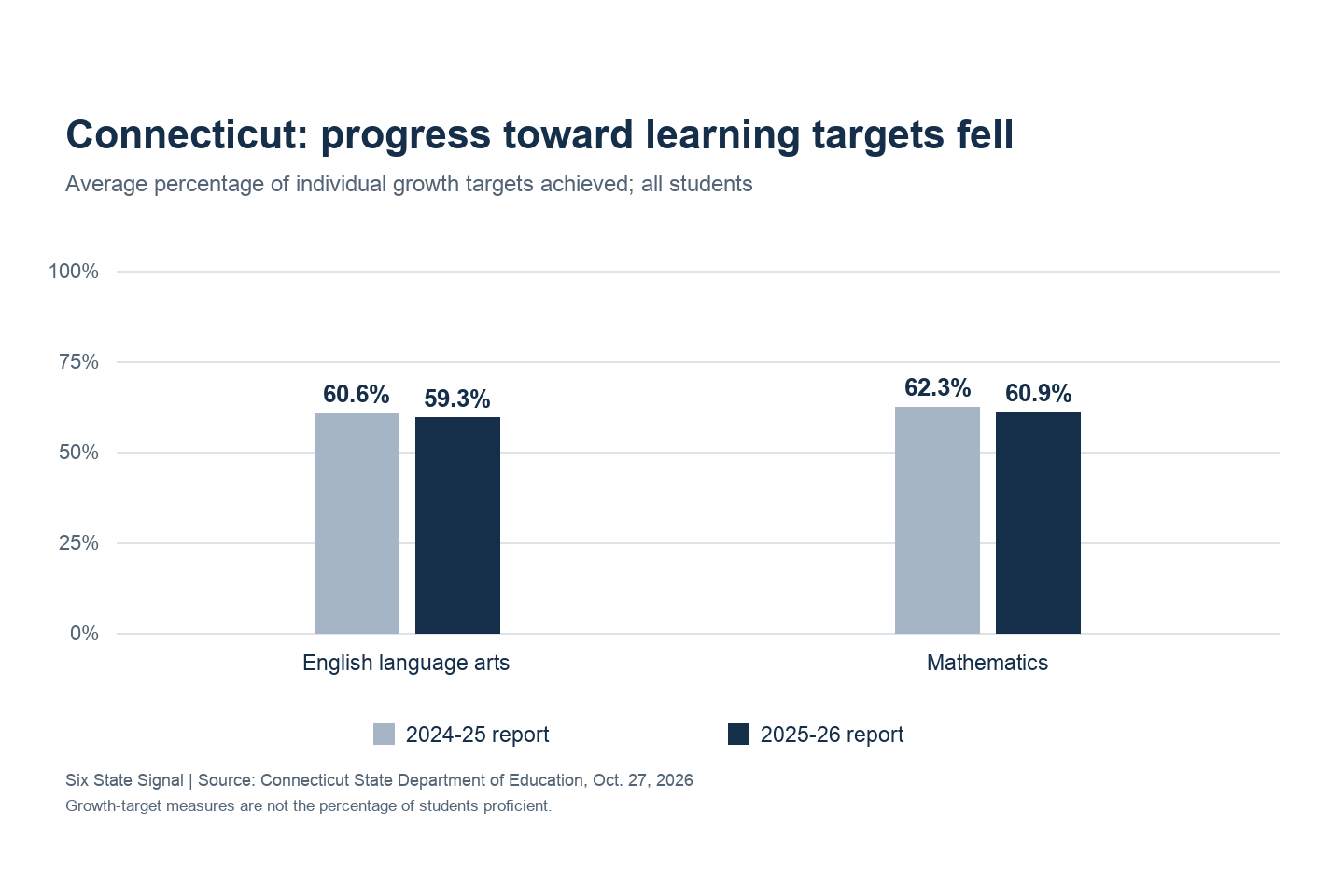
A separate measure asks how much of students' individual growth targets was achieved. The statewide average fell from 60.6% to 59.3% in English and from 62.3% to 60.9% in math. Those figures describe progress toward targets, rather than the share of students reaching grade-level proficiency.
The pattern also appeared in the state's high-needs student group, which includes students with disabilities, English learners and students eligible for free or reduced-price meals. Its average share of growth targets achieved fell from 55.7% to 54.8% in English and from 55.9% to 54.0% in math.
More college credit, continued school support
Among students in grades 11 and 12, 34.6% earned at least three college credits with a grade of C or better, compared with 22.3% in 2021-22. A separate readiness measure counts students who met at least one benchmark on the SAT, ACT, Advanced Placement or International Baccalaureate exams. That share reached 49.9%, up from 47.2% the previous year.
The overall accountability index rose from 71.8 to 72.2, still below 74.2 in 2018-19. The index is the percentage of available points earned across 12 indicators, including achievement, growth, attendance and preparation for life after high school.
The state recognized 138 Schools of Distinction and identified 72 schools for additional support. Of those, 40 are Turnaround Schools designated for comprehensive improvement and 32 are Focus Schools receiving help with particular areas of performance. The workbook also lists schools leaving particular support categories; leaving one category does not necessarily mean a school no longer receives additional support.
Families can find their district and school results in the EdSight dashboard. The state also provides a workbook listing school categories and support designations.