

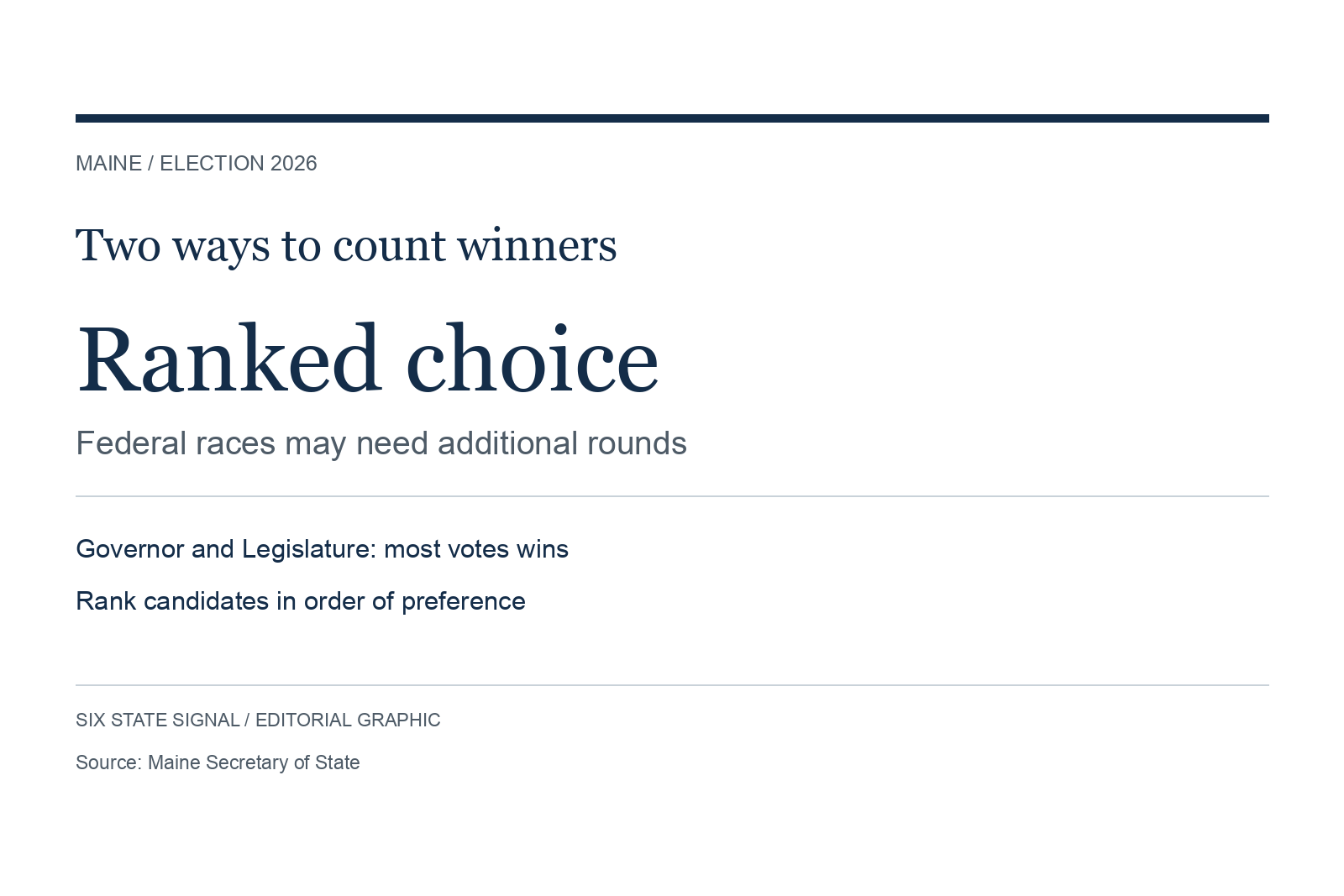
Maine's Nov. 3 ballot brings two different ways of choosing winners: ranked-choice voting for federal races when additional rounds are needed, and a most-votes-wins count for governor and state legislative seats.
The distinction matters when reading election-night results. In a ranked-choice race with more than two candidates, the first-choice leader may not yet be the winner if no candidate has a majority.
The secretary of state's explanation says voters rank candidates in order of preference. If additional counting is required, last-place candidates are eliminated round by round and their ballots transfer to the next candidate the voter ranked who remains in the race. The final winner has more than half the votes in the final round.
When no candidate wins a majority on election night in a qualifying race, ballots and voting-machine memory devices are securely transported to Augusta for central counting, the office says.
The state's 2026 resources page, updated Oct. 6, includes sample ranked-choice ballots for U.S. Senate and the 2nd Congressional District, along with marking instructions.
A ballot can stop transferring if it no longer ranks any candidate still in the race. The state calls that an exhausted ballot.
General elections for governor, state senator and state representative use plurality: the candidate with the most votes wins, even without a majority. The secretary's office traces that difference to the Maine Constitution and the Maine Supreme Judicial Court's May 2017 advisory opinion.