

Rhode Island voters will decide Nov. 3 whether the state may borrow $120 million for housing under Question 2. The Yes on 2 campaign says public investment is needed to close the gap between what residents can afford and what the market produces on its own.
A May report from the Rhode Island Public Expenditure Council questioned the cost of recent state-funded developments and called for reserving more future bond money for middle-income housing. The report does not recommend rejecting Question 2.
The voter handbook says the money would increase housing availability and supply, revitalize communities and promote affordable homeownership through new construction and renovation of existing buildings. Under the question, at least $25 million would go toward production of homes intended for ownership. Up to $10 million could support a public-housing development program.
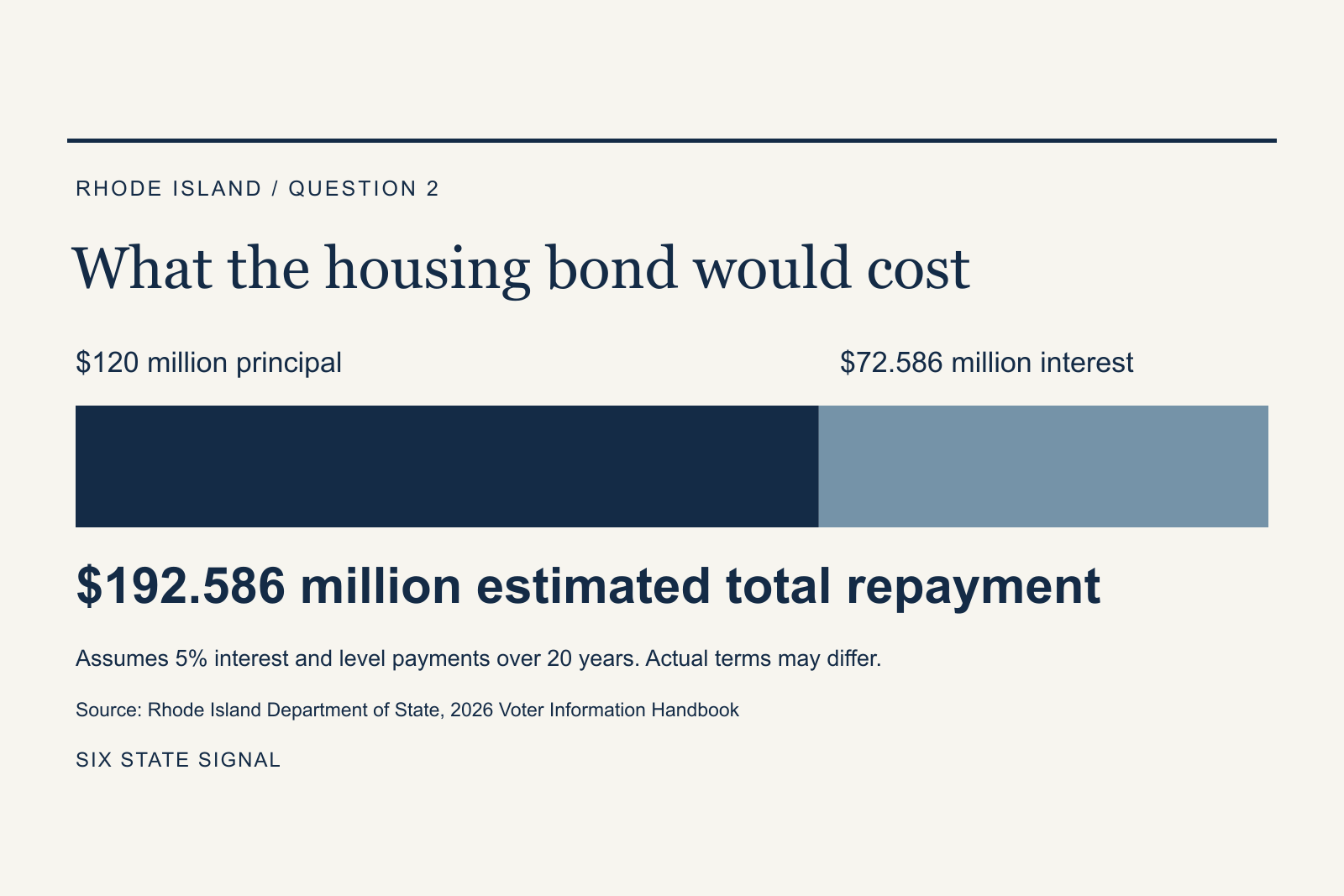
The estimated repayment cost exceeds the $120 million borrowed. The handbook estimates $72.586 million in interest and $192.586 million in total repayment, assuming a 5% interest rate and level payments over 20 years. Those are estimates; actual borrowing terms would determine the cost.
The Yes on 2 campaign launched Oct. 13 with support from housing advocates and community organizations. Housing Network of Rhode Island Executive Director Melina Lodge said Rhode Island continues to face challenges with housing affordability and availability.
The campaign says public investment is needed for homes that the market does not produce at prices residents can afford. It describes the bond as supporting homes across a range of incomes, including for families, older adults, workers, people with disabilities and aspiring homeowners priced out of the market.
The campaign disclosed that its effort is funded in part by the Partnership for Rhode Island and the Rhode Island Foundation, as well as fundraising from organizations and individuals. That is the campaign's account of its backing, not a complete accounting of contributions and spending.
RIPEC's criticism concerns the design and results of housing programs. Its May report analyzed an April 2026 funding round in which $52.2 million from the 2024 bond and other state sources financed five developments with 200 newly constructed units. Of those, 184 were income-restricted affordable units and 16 were market-rate.
The report calculated average total development costs of $512,377 per newly constructed unit. That figure includes the full development cost, not just the state's contribution. The units were financed in the funding round; the figure is not a count of 200 completed homes available for occupancy.
RIPEC recommends reserving at least half of future housing bonds for middle-income housing, using cost controls to increase production and simplifying housing programs.
The campaign describes the bond as serving a range of incomes; RIPEC wants at least half of future housing bonds reserved for middle-income housing and more units for each public dollar. The ballot language would authorize a funding amount and broad uses, rather than promising a fixed number of completed homes.
If the bond is approved, projects are expected to begin by 2028 and be completed between 2029 and 2032, according to the handbook. Approval permits the borrowing; rejection denies this bond authorization.
Sources: Rhode Island voter handbook, Question 2 and borrowing estimates; Yes on 2 campaign launch statement; RIPEC's May 2026 housing strategy research.