

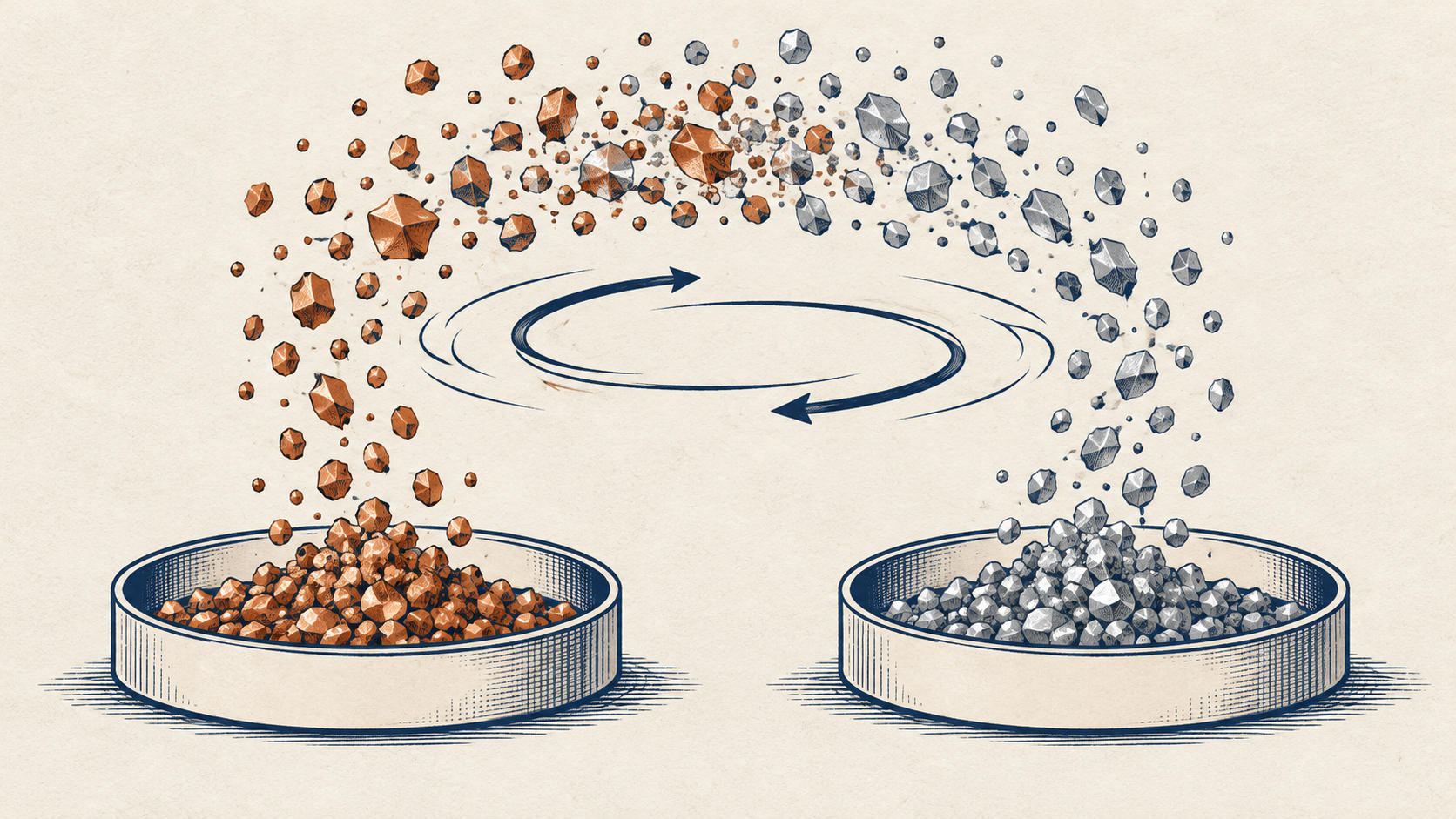
University of Maine researchers have tested a process that could help manufacturers separate mixed metal powders instead of throwing them away, though the method is not ready for industrial use.
The team mixed microscopic aluminum and copper particles in liquid, then used a spinning system and a polymer film to capture particles. Changing the speed changed which metal predominated in the captured material, according to the researchers' Oct. 22 announcement.
Metal powders are used in some forms of 3D printing and other manufacturing. When powders mix or become contaminated, they may no longer meet requirements for reuse even if they still contain useful metal.
The experimental method is called shear-assisted particle entrapment, or SHAPE. Mechanical engineering associate professor Bashir Khoda developed it with collaborators at UMaine and the University of California, Los Angeles.
At about 200 revolutions per minute, roughly 87% of the particles captured on the film were aluminum. At 1,500 revolutions per minute, about 90% were copper, the university said. Those percentages describe the composition of captured particles, not the percentage of all starting metal recovered.
The overall amount captured remained relatively low under laboratory conditions. The team must increase throughput, meaning how much material it can process, and establish whether recovered powders retain the properties needed for manufacturing.
The university said the study appeared in Powder Technology and received partial National Science Foundation support. Further experiments will test other material combinations and changes in the process.
The current finding is that the method can favor different particles under different conditions. Less waste, less energy-intensive reprocessing and commercial-scale recovery remain goals rather than demonstrated results.