

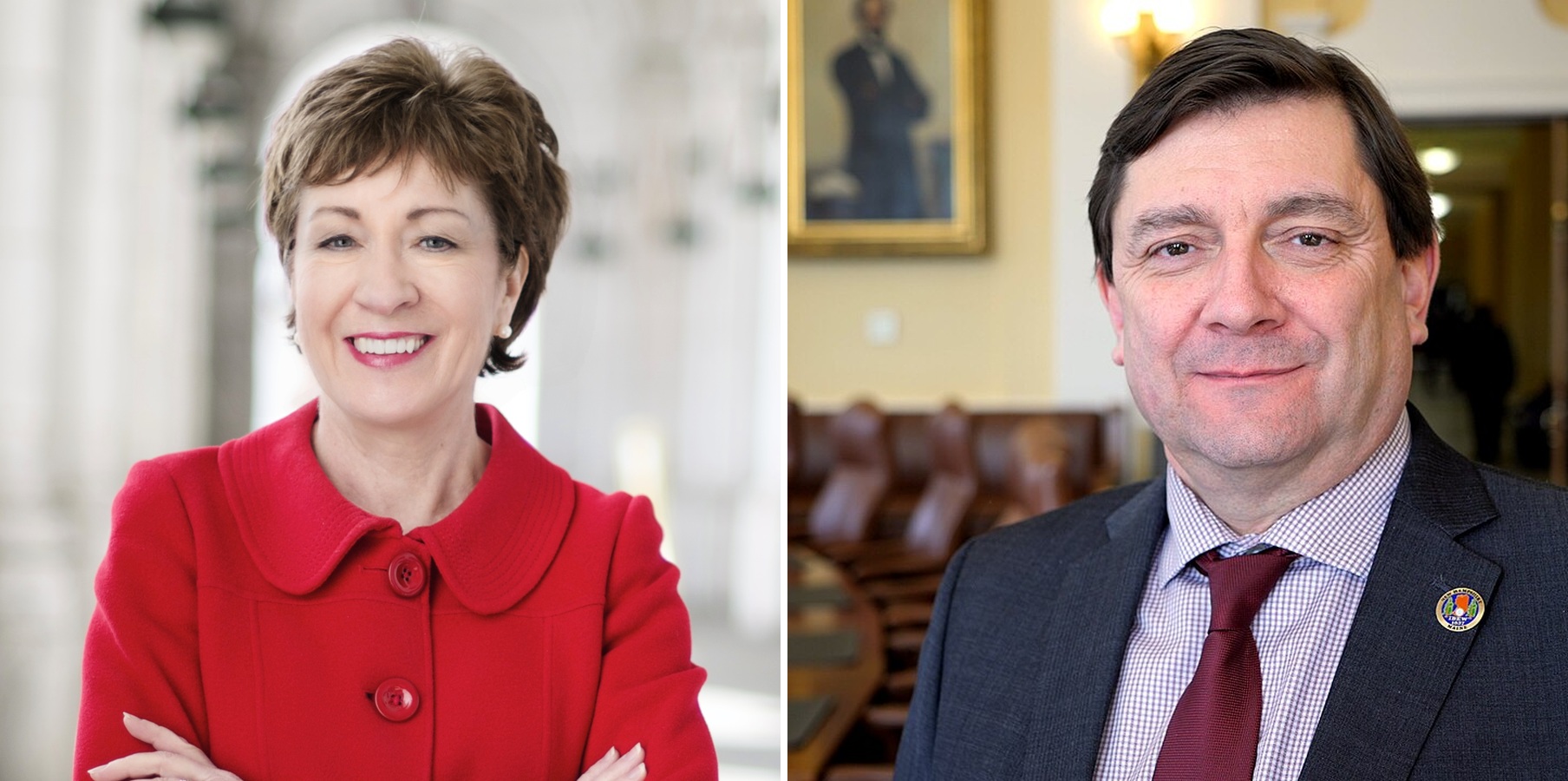


Susan Collins and Troy Jackson offered Maine voters different answers to a question that goes beyond the number of seats on the Supreme Court: how should Congress respond when one candidate sees judicial independence at risk and the other sees a court already compromised?
In their Oct. 15 Senate debate, Collins opposed expanding the court. Jackson supported ethics changes and term limits and said, "I'm not against putting more people on the court." He did not specify a number of new seats or a timetable in that exchange.
The distinction matters. Adding justices could change the court's voting balance. It would not, by itself, create an independent ethics investigator or make appointments more predictable. Those goals require different rules, with different legal obstacles.
Nine is a law, not a constitutional requirement
Federal law sets the court's membership at a chief justice and eight associate justices. Congress could change that number through legislation. The court's own history records that the first Judiciary Act established six seats in 1789 and that the authorized number has been nine since 1869.
Collins argued that increasing the membership would undermine the founders' vision of an independent judiciary. When Jackson noted in the debate that nine is not in the Constitution, Collins agreed, saying expansion was instead "inconsistent with the whole idea of the Supreme Court being insulated from politics." Her objection is an argument about restraint, not a claim that nine has constitutional protection. The Constitution created the Supreme Court without specifying its size.
That leaves a consequential distinction between having power and using it wisely. Congress has authority over the number of seats. Whether using that authority to change the court's direction would strengthen the institution is a separate question.
Who would get the new appointments?
The Constitution gives the president the nomination power and the Senate the power to approve nominees. Electing Jackson would give him a vote on appointments and legislation, not the power to choose justices himself.
If Congress created immediately available seats while Donald Trump is president, Trump would nominate people to fill them. A Democratic Senate could reject his choices, but it could not substitute its own nominees. Any law postponing new appointments would have to spell out when the seats became available.
This is a practical limitation on treating expansion as an immediate way to counter Trump's influence. The result depends on the design of the legislation and who controls the appointment process when it takes effect. More seats do not inherently favor either party.
There is also a difference between passing a bill and confirming a nominee. Under the Senate's ordinary legislative procedures, ending a filibuster generally requires three-fifths of all sworn senators: 60 affirmative votes when all 100 seats are filled, regardless of attendance. A filibuster allows senators to delay or block a final vote by preventing debate from ending. Supreme Court nominations have a lower barrier: the Senate changed its precedent in 2017 to allow debate on those nominations to end by a simple majority.
A candidate willing to add seats therefore has another question to answer: would he also support changing the Senate's legislative procedures if opponents blocked the bill?
What more Democratic seats would change
The Senate's current roster lists 53 Republicans, 45 Democrats and two independents. If both independents vote with the Democrats, that bloc has 47 seats. A Jackson victory, with every other seat unchanged, would make that 48 against 52 Republicans. It would narrow the majority without changing control. Losses elsewhere could offset that gain.
With those two independents voting with Democrats, a net gain of three seats would produce a 50-50 Senate. The vice president can break ties, so a united Democratic caucus of 50 could not defeat a nominee supported by all 50 Republicans and the Republican vice president. Four net gains would produce a 51-seat Democratic caucus, enough to defeat a nomination if all 51 opposed it and everyone voted.
A smaller Republican majority would still make defections or absences more consequential. A Democratic majority could withhold confirmation and press Trump to choose someone acceptable to some Democrats. That could produce compromise or a prolonged vacancy. It would not guarantee a moderate justice, and party labels do not guarantee how individual senators vote.
Those votes concern existing seats as well as any proposed expansion. A Democratic majority could block a replacement nominee without adding a single justice. Creating new seats would still require legislation to pass both chambers and become law. The president could veto it; overriding a veto requires two-thirds of each chamber under Article I.
Collins's argument faces the history of appointments
Collins's warning identifies a real institutional risk. If a governing party can add enough justices to overcome decisions it opposes, the court becomes easier for elected officials to pressure. A later government could invoke the same justification. The Biden-appointed 2021 commission on Supreme Court reform examined that danger alongside the case for expansion.
But defending nine seats does not establish that the process of filling them has been insulated from politics. The Senate's historical account records that its Judiciary Committee took no action on Barack Obama's 2016 nomination of Merrick Garland. Trump subsequently nominated Neil Gorsuch to fill that vacancy. In 2020, the Senate confirmed Amy Coney Barrett on Oct. 26, before the presidential election, according to its roll call record.
Collins's own record complicates a simple partisan account. She supported two of Trump's three first-term Supreme Court nominees: she voted for Gorsuch and Brett Kavanaugh, but against Barrett. In an Oct. 25, 2020, statement, she said Garland deserved a hearing and that applying a different election-year standard to Barrett was unfair and inconsistent. Her opposition concerned the timing, rather than a conclusion about Barrett's qualifications.
Her Barrett vote and explanation support her argument for consistent election-year rules. Barrett's confirmation despite Collins's vote also shows the limits of an individual senator's resistance. Preserving the seat count leaves the struggle over vacancies and confirmation timing intact.
The strongest case for expansion is consequently more demanding than dissatisfaction with particular rulings. It is that the appointment process has already been manipulated and that leaving the resulting membership untouched preserves the consequences. The strongest objection asks how a corrective expansion would establish a lasting limit that a future majority would accept. Neither question is answered simply by calling the court political.
Changing the majority would not enforce ethics rules
Jackson connected his position to concerns about gifts, travel and judicial conduct. Those concerns raise a different institutional problem: who determines whether a justice has violated a rule, and what follows?
The court adopted a written code of conduct in November 2023. It addresses financial interests, gifts and recusal, the decision to step aside from a case because of a potential conflict. Its commentary says individual justices decide recusal questions. The code itself does not establish an independent complaints tribunal with authority to impose discipline.
A debate panelist, Phil Hirschkorn of News Center Maine, described a proposal to expand the court from nine to 13 justices. Adding those four seats, or any other number, would not answer those enforcement questions. New appointees would operate within whatever ethics system applied to the existing members. Even if expansion changed outcomes in closely divided cases, that would be a different accomplishment from demonstrating that conduct rules were being enforced.
An enforceable ethics proposal would need to identify who receives complaints, who investigates and what remedies are available. It would also need safeguards against using complaints to harass a justice or remove that justice from a politically important case. Judicial independence protects decisions from retaliation; it does not make financial conflicts irrelevant.
Term limits address a different source of power
Term limits would change how appointment opportunities arise. Today, Article III protects federal judges' tenure during good behavior. Vacancies can result from retirement or death, rather than a regular electoral schedule.
An 18-year system with staggered departures is intended to make appointments more predictable. A president could receive two regular appointments in a four-year term once the system was fully operating. That would reduce the importance of a justice's retirement timing, but it would not guarantee agreement on nominees or prevent the Senate from blocking them.
The 2021 commission examined such designs and recorded disagreement about whether Congress could impose the equivalent of term limits by ordinary law. One approach would move justices to other judicial duties after their period of regular Supreme Court service. Critics question whether that would respect their constitutional tenure. A constitutional amendment would avoid that particular statutory-authority question, but require much broader agreement.
A transition would matter as much as the eventual schedule. A plan covering only future appointees would operate differently from one changing the duties of sitting justices. Jackson's general support for term limits in the debate did not resolve those choices.
What Maine voters can ask each candidate
The debate exchange left different decisions unexplained. Jackson has indicated that expansion is an option. A usable proposal would identify how many seats he favors, when they would become available and whether the same arrangement should apply under a Republican president. It would explain how expansion fits with the ethics enforcement he also wants.
Collins has defended the court against changes intended to alter its political balance. That leaves room for a more specific account of the accountability measures she would accept: independent review of conduct, clearer recusal procedures or other changes that preserve the number of seats. Her 2020 stand also invites a concrete question about how she would make consistent confirmation practices prevail when her own party rejects them.
For Maine, the immediate choice is a senator who would vote on those measures and on nominees. The exchange did not supply proposed rules explaining how either approach would apply when the other party holds power.