

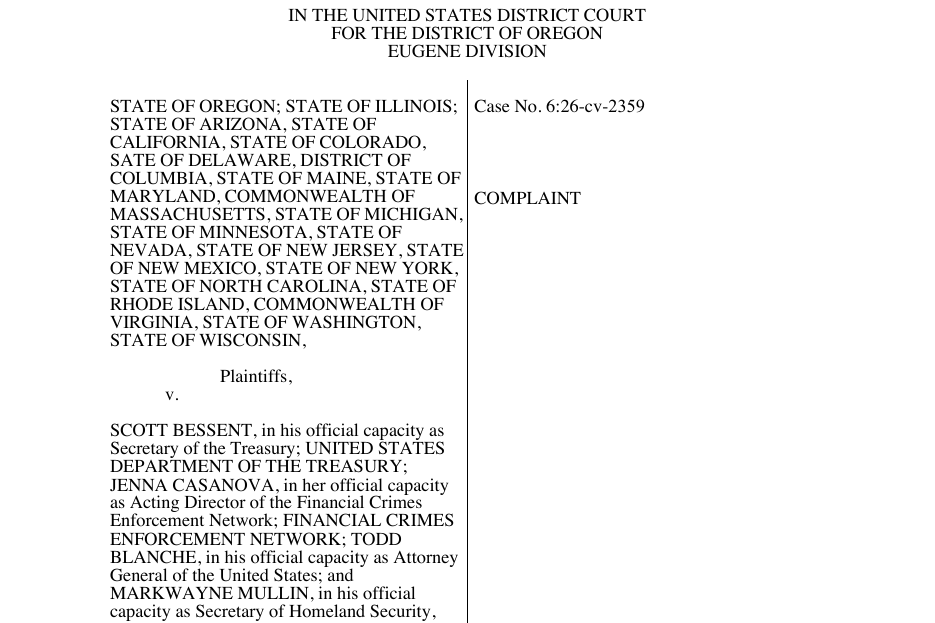
Maine, Massachusetts and Rhode Island were among 20 states and the District of Columbia that sued the federal government Oct. 27 seeking to restore company-ownership reporting requirements and stop the Treasury Department from deleting information that businesses previously submitted.
The complaint, filed in federal court in Oregon, challenges rules that exempt companies formed in the United States and exclude information about U.S. owners of foreign companies.
The case concerns the Corporate Transparency Act, a 2021 law requiring certain companies to identify their beneficial owners: the people who ultimately own or control them. The information goes to the Treasury Department's Financial Crimes Enforcement Network, known as FinCEN.
Why the states want the records
The states say the exemptions remove a tool used to identify people behind businesses involved in money laundering, tax evasion and other crimes. Their complaint argues that Treasury exceeded its authority by exempting virtually the entire domestic-company category Congress covered.
The ownership database is not a public directory. The complaint describes access for authorized government investigators and certain financial institutions under legal safeguards. The states say those records can help trace ownership when a company's registration alone does not reveal who controls it.
They ask the judge to set aside the rules and stop the planned deletion of previously collected records. Those are requests for court action, rather than findings that the rules are unlawful.
Treasury's explanation
In its final rule, effective Aug. 14, FinCEN says the exemptions reduce unnecessary compliance burdens on U.S. businesses. The agency argues that the law gives Treasury authority to create exemptions and requires it to consider reporting burdens alongside the usefulness of the information.
FinCEN also says deleting information no longer required under the rule would protect privacy and information security. Its plan is to remove the exempt information in a single database operation, rather than make repeated deletions whenever someone submits information unnecessarily.
The states argue that Treasury cannot use its exemption authority to undo Congress's basic reporting requirement. Their claims invoke the Administrative Procedure Act, which governs federal agencies' decisions, and constitutional limits on executive power.
The case is Oregon and others v. Bessent and others, No. 6:26-cv-02359, in the U.S. District Court for the District of Oregon.