

At Rhode Island's John J. Moran Medium Security prison, incarcerated handlers help raise dogs that are learning to assist people with disabilities, according to the state Department of Corrections and NEADS, the service-dog organization that runs the training program.
The Department of Corrections describes the partnership with NEADS as operating since 2005. Its community-partners page, last updated May 19, says the Prison PUP Program launched at Moran that year.
The department's published participation figures are historical: about 200 incarcerated people had served as handlers and 300 dogs had passed through the program at Moran as of 2024. Those numbers do not establish how many people or dogs are participating today, or how many dogs ultimately qualified for placement.
A weekday home and a weekend classroom
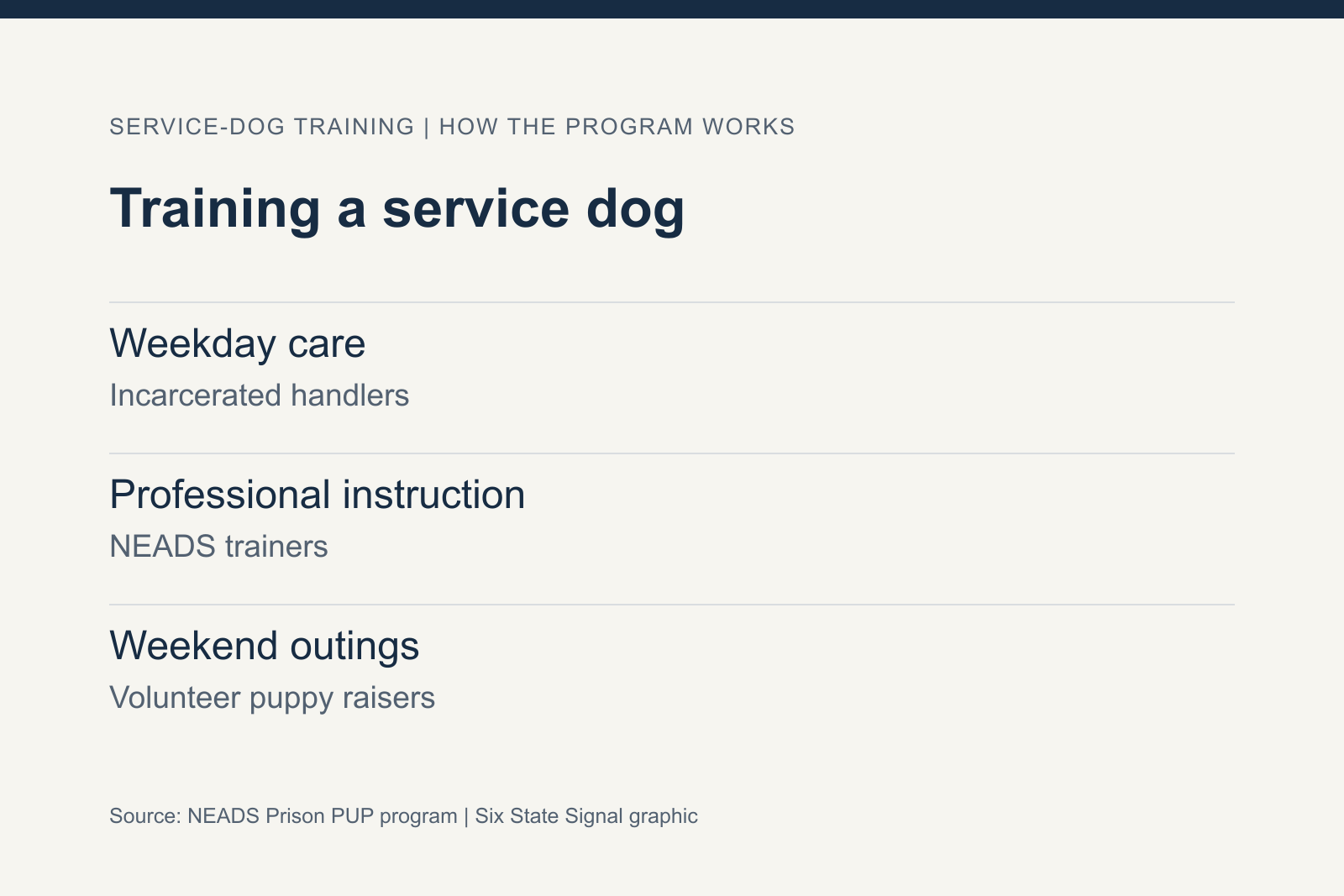
NEADS' Prison PUP program description explains how the arrangement works across its participating institutions. A puppy lives with an incarcerated handler Monday through Friday, then leaves with a volunteer weekend raiser. The organization says 95% of its service dogs in training spend some time in prison, a figure covering its wider program rather than Moran alone.
In NEADS' description, the prison provides a consistent setting for practicing skills and care. The organization says dogs go with their handlers to classes, recreation, meals and the visiting room, and sleep in the primary handler's room. Each dog also has a backup handler, so responsibility does not rest with one person alone.
Weekends supply experiences that a prison cannot: traffic, car rides, shopping, restaurants and other public settings. NEADS says weekend raisers work on socialization, house manners and the skills the dog is learning during the week. The same volunteer is generally assigned to a puppy throughout its time in the prison program.
That division of responsibility makes the volunteer role part of the training itself. A dog expected to work alongside someone in everyday life needs practice around the places, sounds and distractions it will encounter beyond an institution.
Handlers are selected, and trainers stay involved
Participation is not simply a matter of receiving a puppy. NEADS says applicants must meet behavioral-history criteria and commit to 12 to 18 months. A prison liaison selects handlers, and a NEADS trainer then interviews them.
The organization's trainers visit regularly to teach obedience and task work, assess each puppy's progress and assign work for the next visit. Handlers also learn grooming, daily care, basic first aid and health monitoring. The arrangement combines responsibility for a living animal with a structured training program supervised by professionals.
Puppies often enter the program at eight or nine weeks old, although some first spend time with a full-time volunteer raiser. NEADS says a participating facility usually has six to eight puppies and may have as many as 12. Those are general program figures, not a current count for Moran.
The prison program began in 1998 at North Central Correctional Institution in Gardner, Massachusetts, before the Rhode Island partnership started. NEADS lists Moran alongside participating Massachusetts correctional institutions, placing the Rhode Island effort within a regional training network.
The purpose extends beyond the prison
Corrections describes NEADS as breeding, raising, training and matching dogs with children and adults, including veterans, who are deaf or have a physical disability, as well as children with autism and other developmental disabilities. It also identifies assistance dogs partnered with professionals in settings such as classrooms, hospitals and courthouses.
The aim is work the dog can perform for a future partner. A puppy's time at Moran is one stage in that process, not a promise that every dog will graduate or be placed.
NEADS' weekend puppy-raiser program explains how volunteers apply. The organization says it currently accepts weekend-raiser applications only from Massachusetts and Rhode Island residents. Its requirements include taking a puppy out at least three weekends each month, attending monthly training sessions and submitting weekly progress reports. Prospective volunteers can ask about current needs and expectations rather than assuming a placement is available at Moran.