

New Hampshire's Question 2, on the ballot Tuesday, Nov. 3, combines a limit on local school property-tax growth with a separate ceiling on central-office administrative spending. Voters mark one yes-or-no answer. That answer is counted across the towns and wards in the school district for the tax cap and across those in the school administrative unit for the administrative cap.
Under RSA 32:5-i, the tax limit starts with the previous year's local school property-tax levy and adjusts it for inflation and net new taxable property growth. Qualifying bonded capital costs are excluded. Market appreciation, revaluation or reassessment, and changes in assessment methods do not count as new property growth.
The other ceiling limits a school administrative unit's central-office budget to 6% of the combined appropriations of its districts, excluding qualifying bonded capital costs. The law defines central-office spending as general management and administration, including superintendent services, business administration, finance and human resources. The statutory definition excludes school-based administrative staff, classroom instruction and specified school services.
The prescribed ballot wording for towns and wards with an annual school district meeting says the caps apply only to central-office administration and do not affect classroom instruction or school-based services. The tax-levy formula in the same law applies to local school property taxes overall, with qualifying bonded capital costs excluded. SAU 70 says in its explanation that compliance may have broader budget effects depending on each district's financial circumstances and budget.
Each cap requires approval by a three-fifths (60%) majority of voters voting in the towns and wards served by the school district or the school administrative unit. In an administrative unit serving several districts, one cap can pass without the other. Where the unit serves a single district, the two counts draw on the same towns and wards. The Superior Court's Sept. 16 order walked through how split results can occur in a unit serving several districts.
An approved 2026 cap first applies to fiscal 2028 for a two-year period. The law provides override procedures. Gov. Kelly Ayotte signed HB 1300, which created these provisions, on July 15, 2026.
The question may appear on the back of the ballot or on a separate ballot. If it is on the back, the law requires a notice on the front directing voters to turn it over.
What the September court orders decided
David Bates and Kelly Wieser challenged the question, arguing that its wording was confusing and misleading. Merrimack County Superior Court denied their request to block it on Sept. 16. A single New Hampshire Supreme Court justice denied an emergency restraining request the next day. Those orders denied temporary relief; they did not decide that every constitutional claim lacked merit. In denying the injunction, the Superior Court called the plaintiffs' evidence that the caps would inevitably affect classrooms speculative at that stage.
In a Sept. 18 order, a single Supreme Court justice directed the secretary of state to respond by Sept. 23 to the plaintiffs' emergency petition asking that court to take the case directly.
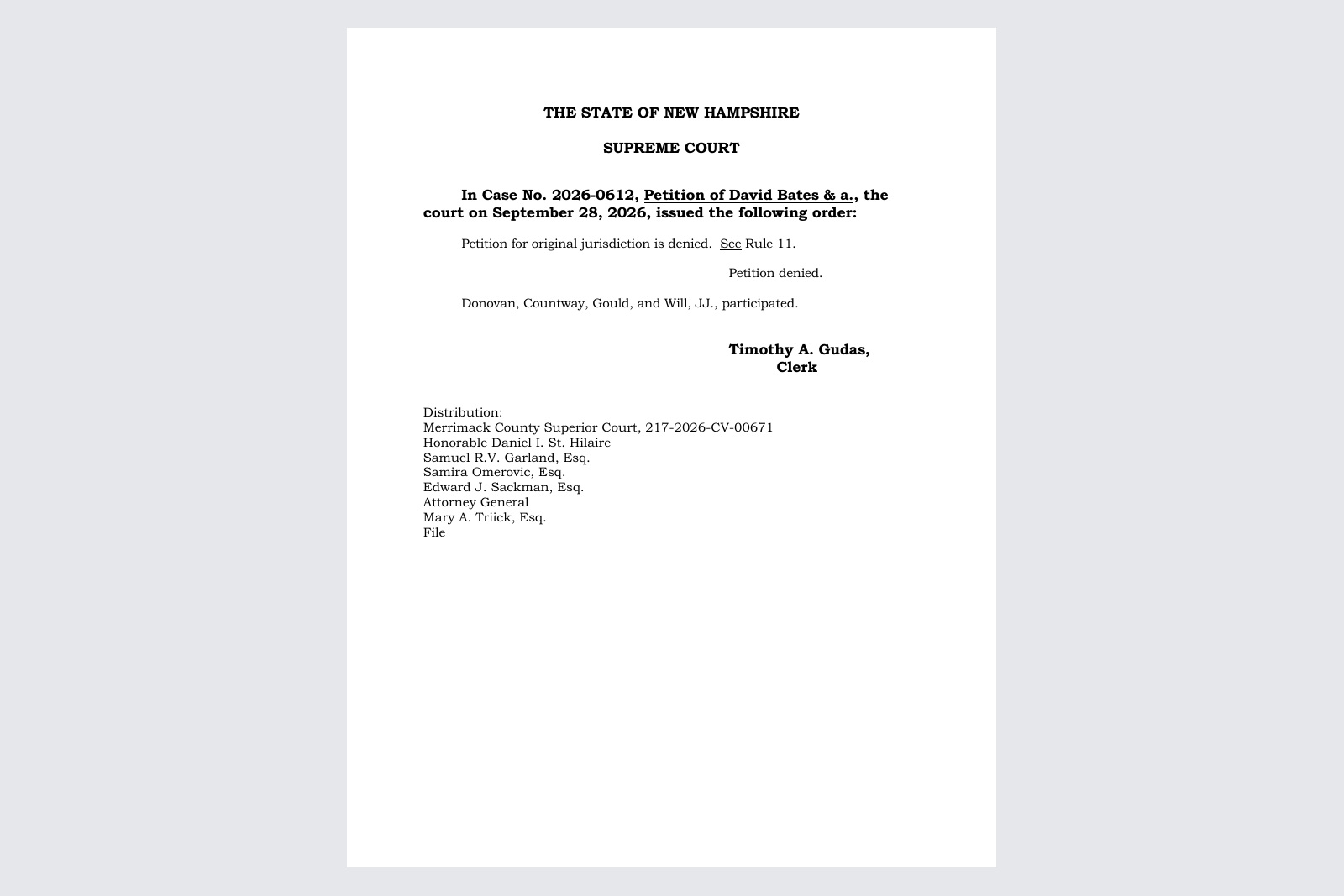
The Supreme Court later denied the petition for original jurisdiction on Sept. 28, declining to take up the case directly under Rule 11. The one-page order does not give a merits ruling on the constitutional claims.
The court's LUCIE public case summary, retrieved Nov. 2, lists a Sept. 16 request by the plaintiffs for an interlocutory appeal, an appeal before a final judgment. It also lists Secretary of State David Scanlan's Oct. 14 motion to dismiss the trial case and his objection to the appeal request. The summary shows deadline extensions granted Oct. 8, Oct. 13 and Oct. 19, but does not give the revised deadlines.
The summary lists no future hearing or judgment. It does not show a ruling on those Oct. 14 filings. The Signal has not obtained the underlying October filings or extension orders, so their detailed arguments and the revised deadlines remain unconfirmed. The Judicial Branch warns that LUCIE summaries may be incomplete and are not the official court record.